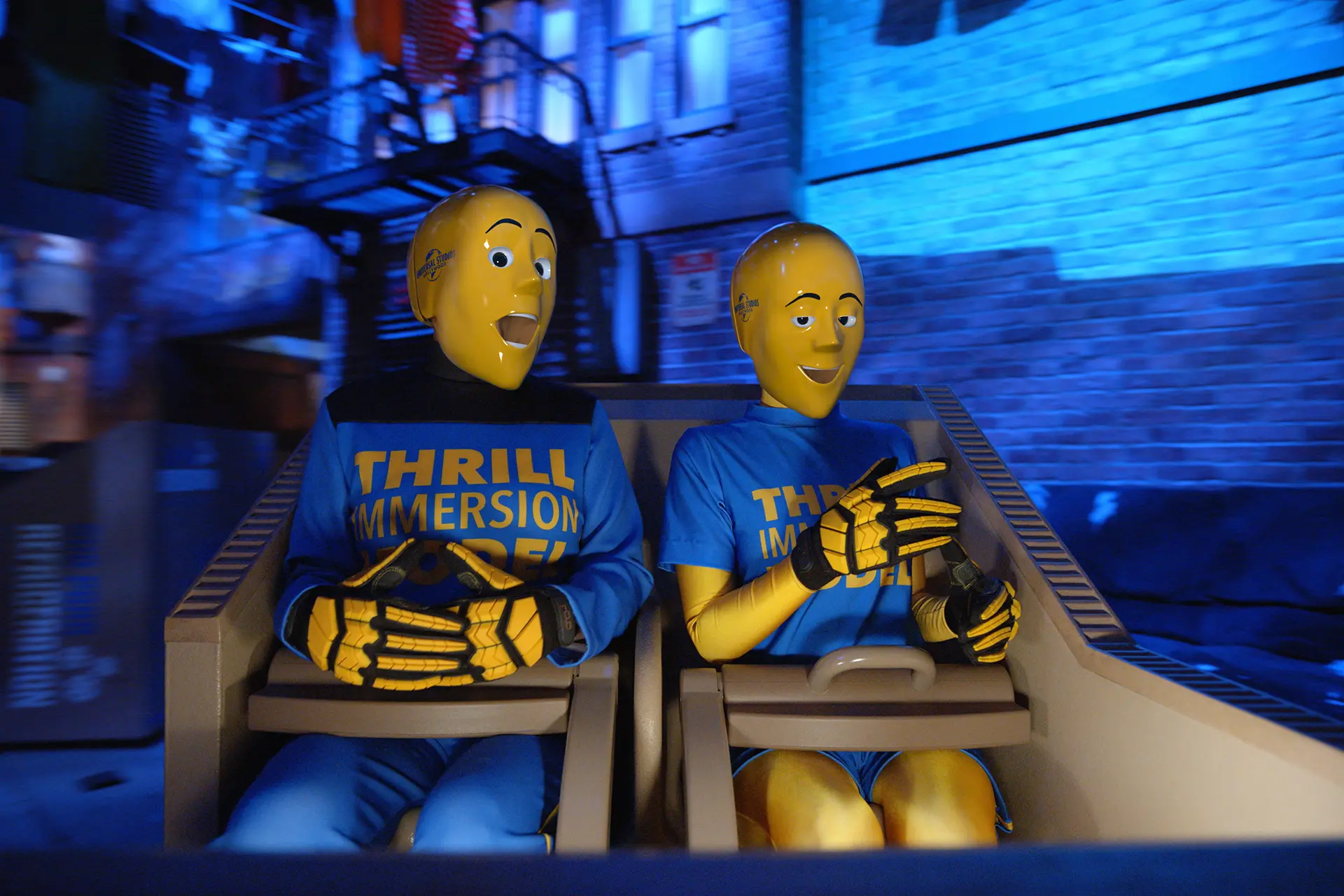
A Universal Studios Hollywood TV commercial by Pixeldust, with CGI head replacements giving crash-test-dummy actors lifelike reactions on new rides.
How do you prove a theme park delivers the best day in LA? You send in the experts. For Universal Studios Hollywood’s “Tested to Make the Best Day in LA” campaign, a team of crash-test dummies, the Thrill Immersion Models, was put through the park’s biggest rides. There was just one problem: test dummies don’t have faces, and this campaign lived on their reactions.
Pixeldust gave them one. Actors in dummy suits rode the attractions wearing 3D-printed marker helmets, and our team replaced every helmet with a CGI dummy head that gasps, grins and screams right along with the ride. The finished TV commercial, delivered in English and Spanish, plays like hidden-camera footage of the happiest crash tests ever run.
The trick started on set. Pixeldust designed and 3D-printed helmets covered in tracking markers, and the actors wore them on every ride. Each helmet gave our team a precise reference to lock onto in post, where it was replaced in Nuke with a detailed 3D test-dummy head capable of complex expressions and dialogue. The actors’ real reactions were the heart of the campaign, so every scream and grin was studied before a single dummy head was animated.
A CGI head only sells if it moves exactly with the actor. Using Foundry Nuke’s 3D object tracking, the team locked every helmet into place, frame by frame. Shots on moving rides needed extra precision, so we added micro-tracking setups and mirrored the camera data inside Nuke for every plate, giving the 3D helmets an exact match. On the water ride we went a step further, tracking animated bubbles and water spray onto the helmets so the dummies get just as soaked as the riders.
These dummies don’t just react, they talk. Pixeldust animated their lip sync in Autodesk Maya as they voiced their excitement through each ride. Our artists filmed their own reference performances to capture the TIMs’ priceless expressions, and a robust facial rig with efficient controls let the animators land every beat of dialogue.
To look real, a CGI head has to catch the same light as everything around it. Our VFX Supervisor captured 360° HDRs on site, using custom rigs to record the environment even while the rides were in motion. That photographic data became image-based lighting for rendering the helmets in Redshift inside Maya, so every highlight and reflection matches the plate.
Redshift’s GPU speed and lighting quality made it our renderer of choice, and every helmet was composited in Nuke over the original footage, the same compositing and tracking toolset Pixeldust has trusted for live-action CGI shots for years.