Games That Teach, Train, and Transform — Not Just Entertain
Pixeldust develops serious games and interactive experiences that turn complex learning objectives into engaging gameplay, helping organizations educate audiences, train employees, and communicate ideas that stick.
Work for the Challenger Center, Clever Cents and museum and education partners.
01 — Why us
Learning Games Built by One Team
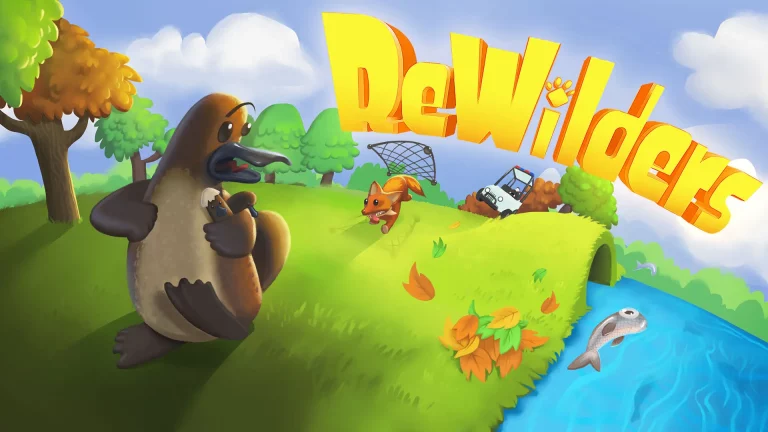
Serious games, designed for education, training, healthcare and corporate goals rather than pure entertainment, have moved from niche experiment to mainstream strategy. A serious game has to work twice: as a game people want to play, and as a tool that meets your goals. Pixeldust designs for both at once, with artists, developers and sound designers working together in-house. Our games include Clever Cents, Rewilders, Breakout Force and the Challenger Center’s Mars rover experience.
We start with what players should learn or do, then design mechanics that make those goals fun. Playable prototypes and testing with real players come early, so you can see what works, and adjust it, before full production begins and budget is committed.
We build for web, mobile and installations, with art, animation and sound produced in-house, so you manage one partner instead of several. After launch we can add levels, content and updates, and the art can be reused in videos and other learning materials.
02 — Process
Our game development process
Every Pixeldust development project follows the same proven six-stage pipeline, refined over two decades of building interactive experiences for broadcast, healthcare, and corporate clients. You review and approve at every stage, so there are no surprises, no scope creep, and no missed deadlines.
Discovery
Learning goals and players defined.
Learning objectives
Player research
Success metrics
Architecture & Planning
Game design and platform plan approved.
Game design document
Platform selection
Feature roadmap
Design & Prototyping
Core mechanics proven in playable prototypes.
Core game loop
Art direction
Playable prototypes
Development
Art, code and content built in sprints.
Game engineering
Art & animation
Analytics integration
Playtesting & QA
Real players shape every iteration.
Audience playtesting
SME content review
Device & bug testing
Launch & Support
Deploy, measure outcomes, keep improving.
Platform deployment
Outcome reporting
Updates & support
03 — Capabilities
What we create
Pixeldust develops serious games and interactive experiences across a range of platforms and purposes. We build educational games for museums, science centers, and cultural institutions that transform complex subjects — from molecular biology to astrophysics — into hands-on experiences visitors remember long after they leave. We create training simulations for healthcare and corporate clients that let learners practice high-stakes decisions in safe, repeatable environments.
Our game development services include browser-based and mobile games that reach audiences wherever they are, touchscreen interactives for kiosks and exhibit installations, multiplayer experiences that encourage collaboration and competition, and data-driven games that adapt difficulty and content to each player’s performance.
We also develop gamification systems that add game mechanics — points, progress tracking, achievements, leaderboards — to existing platforms and workflows, increasing engagement and completion rates without requiring a full game build. Whether you need a five-minute browser game that explains a concept or a multi-level simulation that trains complex decision-making, we design the experience to match your objectives and your audience.
Every game we build is grounded in learning science and validated through playtesting. We do not just make games that are fun — we make games that achieve measurable outcomes, and we build the analytics to prove it. From concept through deployment, we ensure the game serves its purpose and justifies the investment.
Educational games
Molecular biology to astrophysics, turned into hands-on play visitors remember.
Training simulations
Practice high-stakes decisions in safe, repeatable environments for healthcare and corporate teams.
Browser & mobile games
Games that reach audiences wherever they are, from a five-minute explainer up.
Kiosk & exhibit games
Touchscreen interactives built for museum floors and exhibit installations.
Multiplayer & adaptive play
Collaboration, competition and difficulty that adapts to each player's performance.
Gamification systems
Points, progress, achievements and leaderboards added to your existing platforms.
Pixeldust has deep roots in science education and museum exhibit design, having built interactive games for institutions like the Smithsonian and the National Institutes of Health. We develop games that communicate complex scientific concepts with accuracy and engagement, reviewed by subject-matter experts and tested with real audiences.
We also serve corporate clients who need training tools that go beyond compliance checkboxes, healthcare organizations that use simulation to improve patient outcomes, government agencies that need to communicate policy and procedure in accessible ways, and media companies that want to extend their brands into interactive experiences. Our experience across these sectors means we understand both the pedagogical rigor and the production quality that serious games demand.
We work with clients at every scale, from single-interactive museum installations to enterprise-wide training platforms serving thousands of employees across multiple locations and languages.
Museums & science education
Games for institutions like the Smithsonian and NIH, reviewed by experts and tested with audiences.
Healthcare organizations
Simulations that let clinicians and patients practice decisions that improve real-world outcomes.
Corporate training
Training games that go beyond compliance checkboxes, scaling across locations and languages.
Government & media
Accessible games that explain policy and procedure, and brand extensions into interactive play.
The Business Case for Game-Based Learning
Traditional training methods struggle with a fundamental problem: people forget most of what they hear in a lecture or read in a manual. Game-based learning addresses this directly. By requiring active participation, decision-making, and problem-solving, games create deeper cognitive engagement that leads to significantly higher retention rates.
For corporate training, the return on investment is measurable in reduced training time, lower error rates, and faster time to competency. For educational institutions, games increase visitor engagement and dwell time, which translates into higher satisfaction scores and repeat visits. For healthcare organizations, simulation-based training reduces risk by letting practitioners rehearse procedures and protocols before applying them with real patients.
The economics also favor games over traditional content. A well-designed game can be deployed to thousands or millions of users at marginal cost, updated with new content without rebuilding from scratch, and analyzed through gameplay data to continuously improve its effectiveness. The initial development investment yields returns that scale with every additional user.
Game-based approaches also solve the motivation problem that plagues traditional training. Completion rates for mandatory e-learning modules are notoriously low, with employees clicking through as quickly as possible. A well-designed game reverses that dynamic — learners engage voluntarily, spend more time with the content, and retain more of what they learn. When training feels like play, participation becomes something people look forward to rather than something they endure.
Our Game Design Philosophy
We believe the best serious games are the ones that do not feel serious. When a game is designed well, the learning happens naturally through play — through choices, consequences, and the intrinsic satisfaction of mastering a challenge. Our game designers draw on established principles of game design and learning science to create experiences where the mechanics themselves teach the content, rather than wrapping a quiz in a game shell.
Every game we develop goes through extensive playtesting with real users from your target audience. We watch how people play, where they get stuck, what makes them lean forward, and what makes them disengage. That observational data shapes every iteration, ensuring the finished game works for the people who will actually use it.
Let’s build a game with a purpose
Tell us what players should learn, feel or do. We’ll design the mechanics, the art and the platform to get them there.
Pixeldust is an Emmy Award-winning studio with more than twenty years of experience creating interactive content for the world’s most respected scientific and educational institutions. We understand that a serious game has to do two things at once: it has to be genuinely fun to play, and it has to achieve a specific learning or communication objective. If it fails at either, it fails at both.
Our team includes game designers, artists, animators, and developers who have built interactive experiences for museum floors, classrooms, corporate training programs, and public health campaigns. We bring the visual quality of a professional animation studio to the interactivity of a game studio, and the scientific rigor of an educational publisher to the user experience of a consumer product.
That combination of creative craft, technical depth, and educational expertise is rare. It is also exactly what serious game development demands. We do not cut corners on visual quality to meet a budget, and we do not sacrifice learning outcomes to make something look impressive. Every Pixeldust game delivers both.
If you need a game that teaches, trains, or transforms — and does it so well that people actually want to play it — Pixeldust is the team to build it.
“I love their work! Pixeldust was a great work experience, they went beyond expectations, delivering more than what I requested in a very tight timeline.”
L. Martinez
08 — FAQ
Frequently asked questions
A serious game is an interactive experience designed with a primary purpose beyond entertainment — such as education, training, health, or communication. It uses game mechanics like challenges, feedback, and progression to engage users while achieving specific learning or behavioral objectives.
We develop games for web browsers, iOS, Android, touchscreen kiosks, VR headsets, and desktop platforms. We recommend the platform based on where your audience will access the experience and the type of interaction the content requires.
We build analytics into every game to track player behavior, knowledge gains, completion rates, and engagement metrics. This data lets you measure ROI and continuously improve the experience based on real user performance.
Timelines vary with scope and complexity. A focused browser-based game might take 10–16 weeks, while a multi-platform simulation with adaptive content could take 6–12 months. We provide a detailed timeline after the discovery and planning phase.
Absolutely. We collaborate closely with your scientists, educators, trainers, or content specialists throughout development to ensure accuracy and pedagogical effectiveness. Many of our best projects have come from tight partnerships between our design team and a client’s domain experts.