A cape that snaps in the wind. A school of fish that parts around a diver. A spider whose eight legs find the ground on every step. Animating moments like these by hand, one pose at a time, would take weeks. With procedural animation, an artist defines the behavior once and the software generates the motion, frame after frame, as many times as you need it.
This guide walks through the main procedural techniques, in 3D and in 2D, and how studios use them in real projects. For a broader introduction focused on games, read Understanding Procedural Animation.
Key takeaways
- In keyframe animation, the artist sets the poses. In procedural animation, the artist sets the rules and the software creates the poses.
- It shines when motion is too big, too detailed or too unpredictable to animate by hand: crowds, swarms, water, smoke, hair and cloth.
- It works in 3D and in 2D, in real time (games, AR and VR) and pre-rendered (film, TV, commercials and medical animation).
- The strongest work mixes both: procedural systems for scale and physics, hand animation for performance.
Keyframe vs. procedural animation
| Keyframe animation | Procedural animation | |
|---|---|---|
| Who decides each pose | The animator, frame by frame | Rules, physics and algorithms the artist sets up |
| Best for | Acting, timing, comedy, mascots | Crowds, swarms, liquids, smoke, cloth, terrain |
| Late changes | Often mean re-animating | Adjust a setting and run it again |
| Scale | Every extra character adds work | A hundred copies cost little more than one |
Real-time or pre-rendered
Real-time procedural animation is calculated as you watch, so it can react to the viewer. It powers games, AR and VR, and interactive installations: a character’s feet adjusting to uneven stairs, or a creature that turns toward you as you walk past an exhibit.
Pre-rendered (or offline) procedural animation is calculated ahead of time and baked into the finished film. Because nothing has to run at 60 frames per second, it can be far more detailed. This is how film, TV, commercials and most medical animation use it.
The most common procedural techniques
- Physics and dynamics: objects with weight that fall, collide and break, plus cloth and hair that move the way real fabric and hair do.
- Particles and fluids: smoke, fire, water and dust. In medical animation, the same tools move blood cells, drug particles and molecules.
- Procedural rigs and inverse kinematics (IK): limbs that solve their own positions, so a creature’s feet stay planted while its body moves.
- Instancing and cloners: one model copied hundreds of times with variation, then driven by forces and noise to make swarms, crowds and product arrays.
- Noise and expressions: small math-driven drift, wiggle and flicker that make still things feel alive.
- Behavioral systems: characters that follow simple rules, such as flocking, crowd movement or game characters reacting to the player.
Procedural animation in 2D
Procedural animation isn’t only for 3D. In 2D animation and motion graphics:
- Expressions in After Effects drive motion with short lines of code (bounce, follow, oscillate), so changing one value updates a whole sequence.
- Bone rigs with IK keep 2D characters’ walk cycles consistent and easy to edit.
- Generative motion graphics build patterns, kinetic type and data visualizations from rules instead of hand-placed shapes.
The payoff is versioning. When a video needs ten lengths, five languages or a last-minute change, a rule-driven setup updates in minutes instead of being rebuilt.
Where you see it beyond games
- Film and TV visual effects: destruction, oceans, crowds and weather.
- Documentaries: recreating ancient seas and prehistoric worlds full of moving life.
- Medical and science animation: cells dividing, molecules binding, blood moving through a vessel.
- Commercials: liquids, product arrays and stylized particle effects.
- Motion graphics: data-driven charts and type that animate themselves from real numbers.
How we use procedural animation at Pixeldust
At Pixeldust we use Houdini, Cinema 4D, Maya and Unreal Engine, and we mix procedural setups with hand animation on almost every 3D animation project. A few examples:

- HP 710 Rechargeable Silent Mouse: a swirling vortex of mice, built from copies of one model rather than dozens animated by hand.
- Our 3D animation reel: a spider whose legs find the ground as it walks.
- Curiosity – Ancient Oceans: prehistoric seas full of water, particles and moving life.
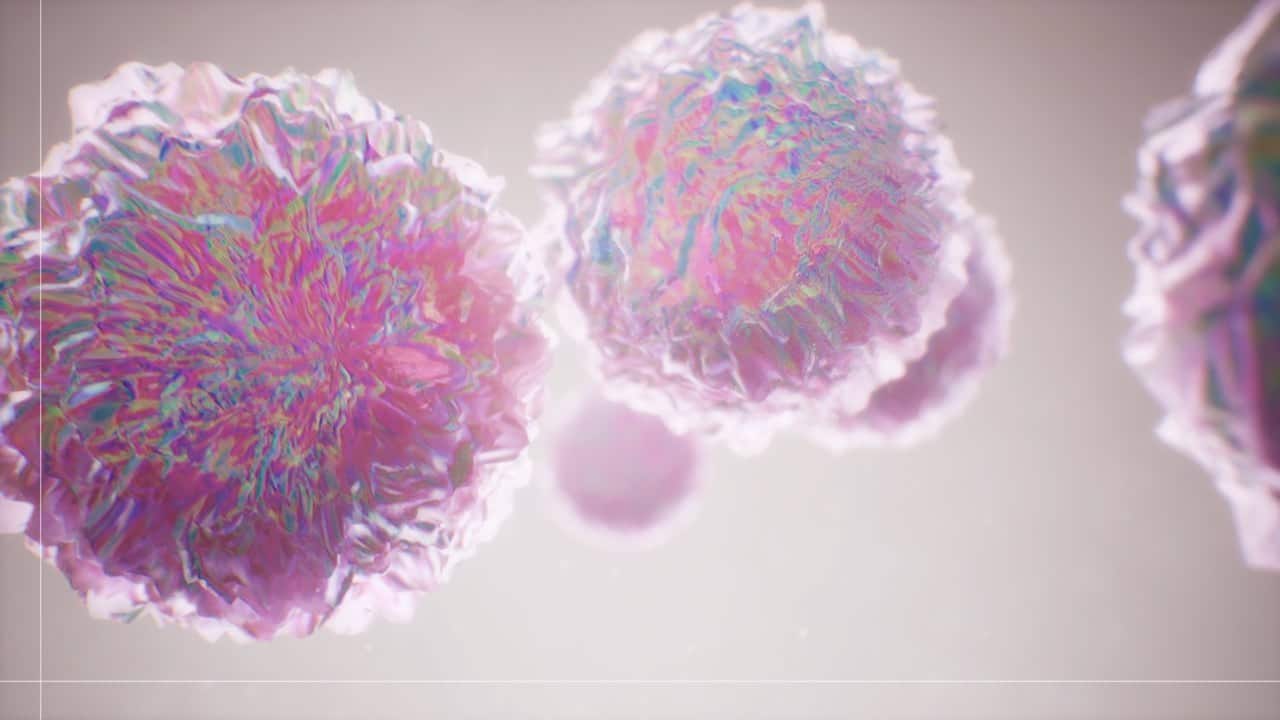
- WebMD – Mantle Cell Lymphoma: cells and particles that show how the disease behaves inside the body.
- Rewilders and Breakout Force: real-time games where motion responds to the player.
When to keyframe instead
Procedural animation is great at scale and physics, but it doesn’t act. A mascot’s double take, a comic beat, or a product turn that has to land on an exact frame still needs an animator’s hand. Most of our projects blend both: rules for the world, keyframes for the performance.
Planning a project with procedural animation
- Describe the behavior, not just the look. “The swarm should part around the product” tells the team more than “lots of mice”.
- Decide early whether it’s real-time or pre-rendered. A game or an exhibit has different limits than a commercial or a documentary.
- Expect to explore. Once the rules are set, trying a faster, denser or calmer version is quick, so use that freedom.
- Bring reference. Clips of the motion you like are worth pages of description.
- Ask about cost early. It depends on the complexity, but when motion would take weeks by hand, a procedural setup is often less expensive than people expect. We’ll give you a clear quote.
FAQ
Is procedural animation the same as AI animation?
No. Procedural animation follows rules that artists write, so the results are controllable and repeatable. AI animation generates motion learned from data. The two can work together, and we use both.
What software is used for procedural animation?
Common tools include Houdini, Cinema 4D, Maya, Unreal Engine and Unity, plus expressions in After Effects for 2D and motion graphics.
Is procedural animation only for video games?
No. Film, TV, commercials, documentaries, medical animation and motion graphics all use it. If you are building a game, see our game development work.
Can 2D animation be procedural?
Yes. Expressions, bone rigs and generative design bring procedural motion to 2D and motion graphics.
Need motion that’s too big to animate by hand?
Pixeldust is an Emmy Award-winning animation studio. Whether it’s a swarm, an ocean or a cell-level look inside the body, we’ll find the right mix of procedural and hand animation for your story.